The Big Issue is a
charity based independent magazine sold every week on the streets of 12
different countries in 4 different continents, originating from London,
England. This magazine leans towards the left wing media as it shows fair
representation of homeless, underclass and immigrants and they are working to
help those groups of people. The people who sell The Big Issue are homeless or
on the verge of homelessness. The Big Issue started to help the homeless an
opportunity to reintegrate them into society, work, and earn money for
themselves. The stereotype of underclass people in the mainstream media is that
they are taking advantage of the system, uneducated, and they are not worthy of
anything, they are often referred to as scroungers, the homeless are seen as
lazy, dirty, alcoholics who just want money for more drugs/drinks, and the
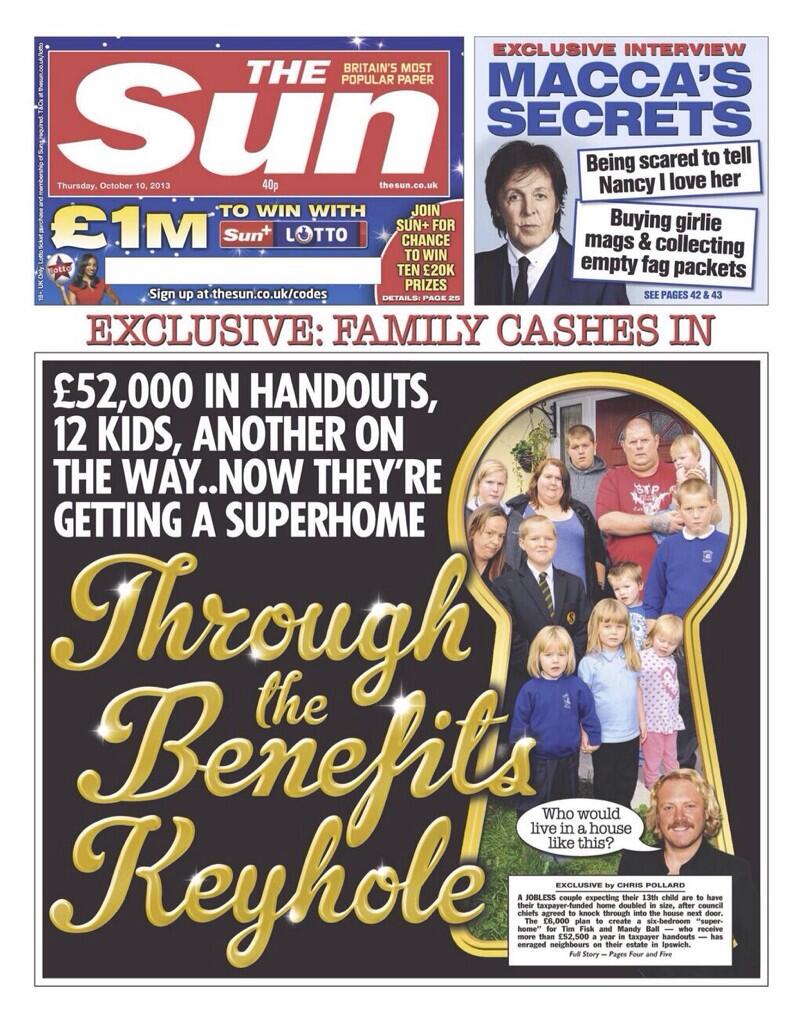
unemployed are seen as taking advantage of the welfare system (through the
benefits keyhole (The Sun) figure a) right wing newspapers such as The Sun and
The Daily Mail are very unfair towards the underclass and immigrants which
could change the perception of people reading those newspapers (http://www.dailymail.co.uk/news/article-4816016/Furious-residents-hit-homeless-shanty-town-pops-up.html)
(http://www.dailymail.co.uk/news/article-4967690/Million-illegal-immigrants-not-removed-UK.html).
The Big Issue fights these stereotypes by having a counter stereotype, showing
that they are willing to better themselves. The Big Issues tagline is “a
hand up, not a hand out”, this shows that The Big Issue is not going to be
working with those that do not put their effort in to make their lives better.
The cover of issue 1273
of The Big Issue is labelled Bob - Big in japan (figure b) The tagline for the magazine is "a hand up not a hand out" this means The Big Issue wants to help the
homeless but wants them to do it for themselves. Bob, the cat has a formal,
direct mode of address towards the audience. Bob has been photoshopped into the
middle of a street in japan, he is bigger or as big as the buildings around him
which links to the movie "Godzilla" which was set in Japan.. The mise
en scene, is filled with very saturated colours like magenta and blue. It is
also filled with references to Japanese pop culture (anime and Godzilla). The
headline font is sans-serif showing that it is modern except from the word
“exclusive” which is a white serif font in a baby blue box. The headline font
is stylized in two different colours, pink and white, with the word “BOB” in
white and the biggest. This brings your eyes to the centre of the cover, this
also makes the reader know that bob is the name of the cat.
The cat on this cover
is the pet of recovered addict, once big issue vendor James Bowen, who is now
an author of three bestselling books, A Street Cat Named Bob (turned movie),
The World According to Bob and A Gift from Bob. Bowen lived on the streets for
years, eventually falling into drug use (heroin), eventually in 2007 going into
methadone treatment where he lived in a supported housing programme. The
turning point for Bowen was Bob. When Bob came into Bowens life he had to care
for something/someone other than himself “I believe it came down to this
little man. He came and asked me for help, and he needed me more than I needed
to abuse my own body. He is what I wake up for every day now... he’s definitely
given me the right direction to live my life." He cared for Bob taking
him to the blue cross clinic to get antibiotics to treat an infection,
eventually Bob was healthy and Bowen released him back to the streets, but Bob
was persistent following Bowen until he took him in. Bob is a big part of why
Bowen has the life he has now as he drew attention towards the vendor, getting
more customers and creating empathy which encouraged people to share his story
and encourage others to go to him.
The Big Issue shines a
hopeful light on the homeless and struggling, helping them to get back on their
feet and offering support to those who need it. Other charities such as Shelter
use empathy to make people feel bad that they haven’t donated and to coerce
them into donating (figure c), charities that use empathy usually use
children/families. (http://www.bbc.co.uk/news/uk-34346908 http://www.independent.co.uk/news/uk/home-news/british-children-homeless-christmas-120000-shelter-poverty-temporary-accommodation-a7395171.html)
Though in my opinion they should show all sides of homelessness, men, women,
families, and young people, I think this because I don’t think charities should
only focus on one specific group of homelessness while ignoring the others,
because some groups don’t get the media representation that others do, so
they’re having to work extra hard themselves just to get that recognition that
is given to other groups.


You have produced a good analysis of the magazine through an analysis of media language including the analysis of font, mise en scene and intertextual references. There is a need for you to communicate the commonly held representations of the poor/working class through theorists such as Butsch and Shildrick and Macdonald. these is some good analysis on the ethical position of the Big Issue compare to the tabloids.
ReplyDeletei would suggest more could be said about the use of Bob as a symbol of homelessness, here you could reference the homelessness statistics in London/Uk and discuss how they are on the rise. Finally ref. The Big Issues selection of Bob for the front cover why was done as opposed to featuring a real homeless person. Overall grade C+